Projects

IC Projects

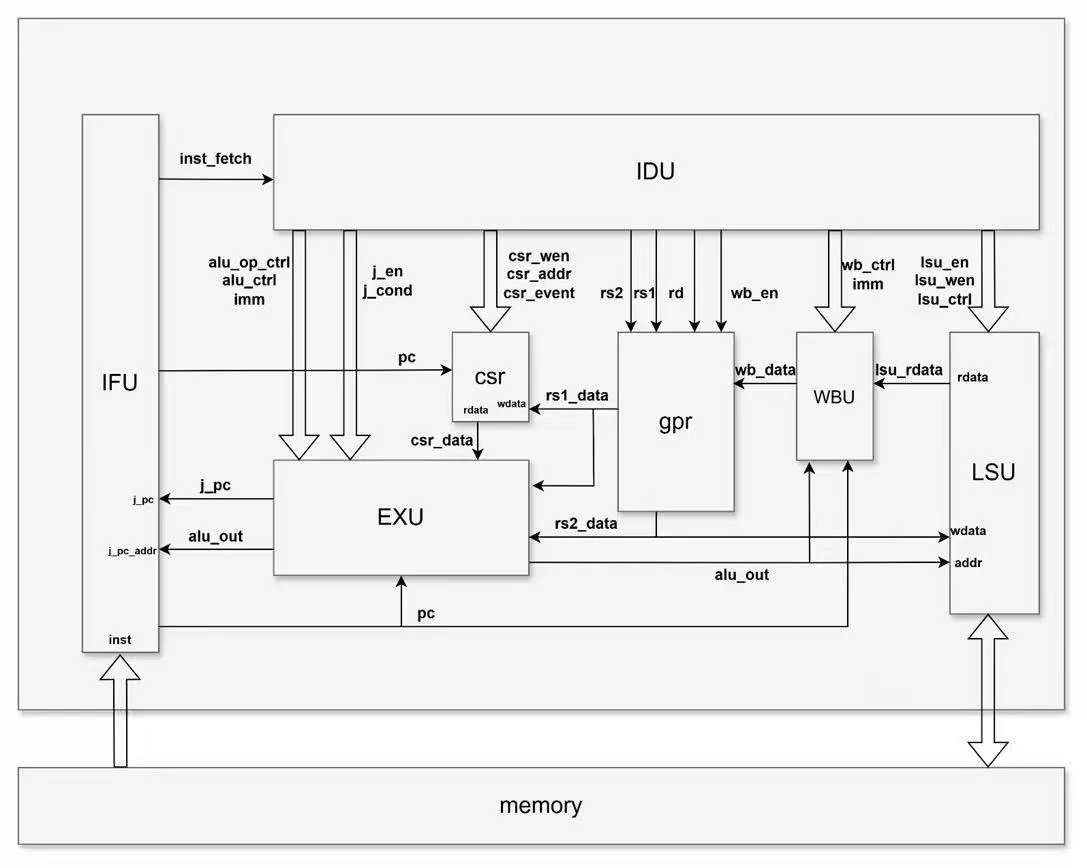
RTL RISC-V CPU architecture diagram

RTL RISC-V CPU Implementation & Verification

Designed and verified a multi-cycle RTL RISC-V CPU with latency-insensitive handshake-based microarchitecture, differential testing, and RTOS bring-up.

  • Designed a modular multi-cycle RV32E CPU (IF/ID/EX/LSU/WB) with valid-ready handshake for stage and memory interaction
  • Implemented machine-mode privilege architecture including CSR subsystem and precise exception/trap handling
  • Built a C reference model (RV32E + M) and developed differential testing (DUT vs. reference) for instruction-level verification
  • Integrated a custom SimpleBus-based memory interface with request/response protocol supporting variable-latency access
  • Designed and integrated an AXI4-Lite read interface for instruction-fetch memory access, enabling bus-based external memory communication
  • Developed a Verilator-based simulation framework with waveform tracing, instruction/memory trace, and debug tooling
  • Successfully booted RT-Thread RTOS on the RTL CPU, validating system-level execution and exception handling

Tools: Verilog, C/C++, Python, Verilator, GTKWave, RISC-V ISA, Difftest

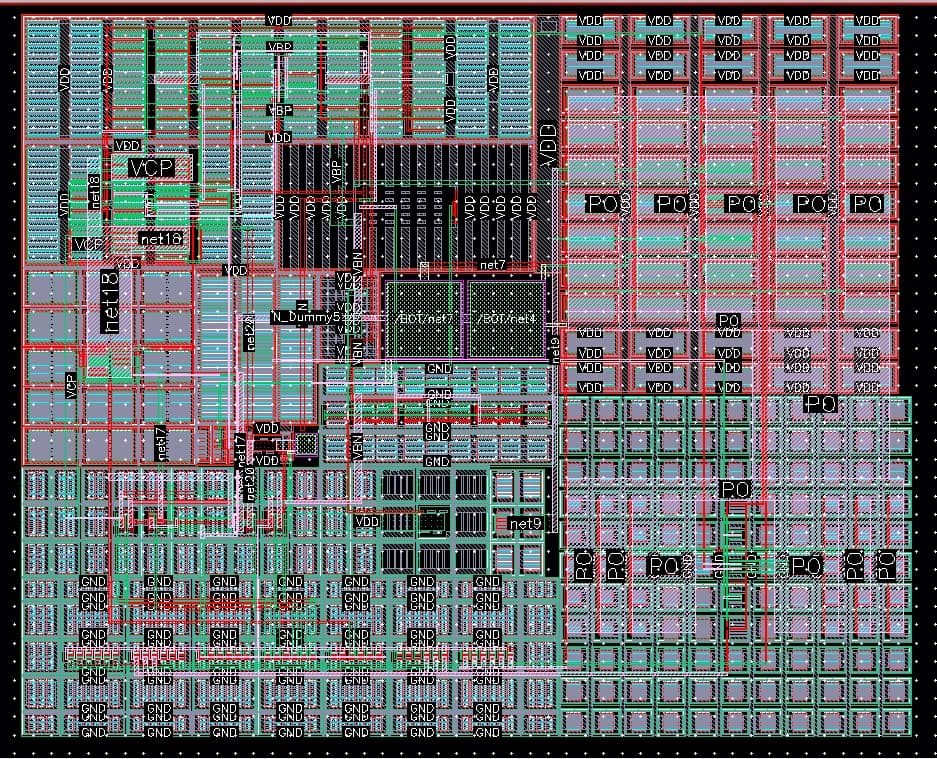
bias schematicOp-amp layout

Class-AB Audio Amplifier Design in GF 0.18-μm CMOS

Designed a class-AB audio amplifier with full-custom layout and post-layout verification.

  • Designed amplifier, bias, and start-up circuits
  • Applied translinear-loop class-AB control and Ahuja compensation
  • Completed layout with DRC/LVS clean and PEX
  • Verified performance across PVT corners
  • Achieved ~12-dB gain, ~300-kHz UGBW, >60° phase margin

Tools: Cadence Virtuoso, Spectre, Layout, DRC, LVS, PEX

Cross-coupled charge pump schematicCharge pump transient simulation

Digitally Controlled Cross-Coupled Charge Pump in 0.18-µm CMOS

Designed a 2-stage cross-coupled charge pump with 4-phase non-overlapping clock generation and closed-loop digital regulation in Cadence Virtuoso.

  • Designed a 2-stage cross-coupled charge pump for on-chip voltage boosting
  • Implemented 4-phase non-overlapping clock generation to improve charge transfer stability
  • Optimized device sizing and pumping capacitance to balance boosting capability, ripple, and startup behavior under leakage effects
  • Built a bang-bang closed-loop digital control scheme using comparator feedback for output regulation
  • Achieved regulated output of 2.94-3.01 V from a 1.8 V supply with about 70 mV peak-to-peak ripple under ~100 kΩ load in schematic-level simulations

Tools: Cadence Virtuoso

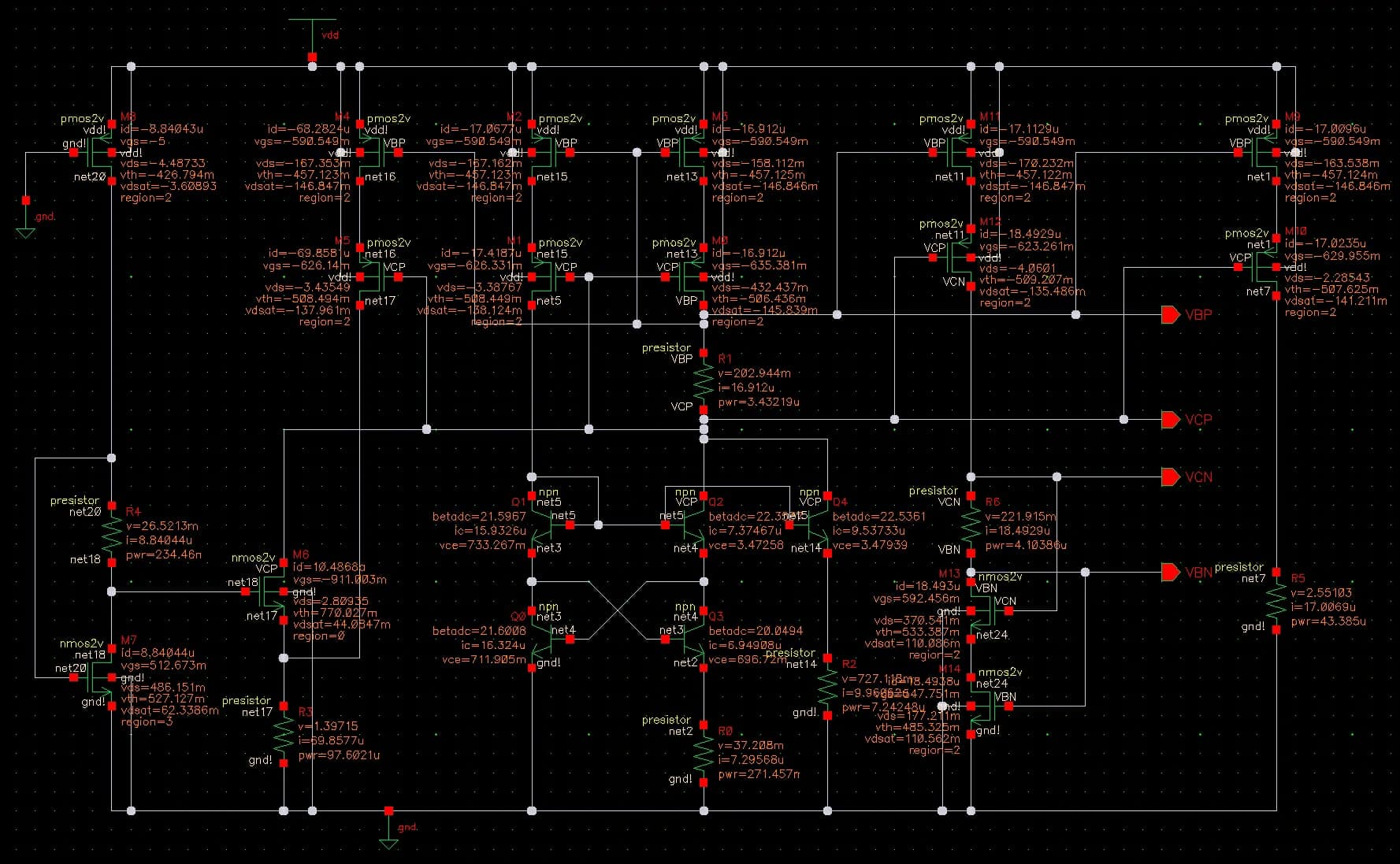
Bandgap schematic

Bandgap-Based Reference Voltage Design in TSMC 0.18-μm CMOS

Designed a temperature-compensated reference circuit based on BJT ΔVbe generation and PTAT/CTAT compensation.

  • Implemented ΔVbe generation using BJT area ratio (N = 4)
  • Designed bias network and current mirrors for stable operation
  • Optimized resistor ratios to balance PTAT and CTAT components
  • Achieved ~25 ppm/°C over -40°C to 100°C
  • Output reference voltage ~2.54 V

Tools: Cadence Virtuoso, Spectre

Competitions

Multi-Vehicle Formation System (17th National College Smart Car Competition, WCH Track)

Triple-vehicle coordinated racing system with path tracking, road recognition, and overtaking.

  • Designed a three-vehicle cooperative control system within a 5-member team, enabling coordinated tracking and overtaking via wireless communication
  • Developed custom electromagnetic sensing module for path tracking using AC-driven wire, enabling robust line detection
  • Implemented multi-loop PID control for motor speed, inter-vehicle spacing, and steering servo angle
  • Built full hardware system including sensor module, motor driver, and custom PCB (CH32V307 + STC16)
  • Designed wireless networking between vehicles for real-time state exchange and cooperative decision-making
  • Performed embedded software development and parameter tuning for control stability and high-speed operation
  • Integrated 3D-printed mechanical structures for chassis and system assembly
  • Achieved 2nd place in East China region and National Second Prize in a high-speed autonomous racing competition

Award: National Second Prize

Tools: CH32V307, STC16, Embedded C, Sensors, Motor Control

Dual-Vehicle Following System - TI Cup National Electronic Design Contest

Dual-vehicle system with sensor tracking and autonomous distance control.

  • Designed a dual-vehicle cooperative system with Bluetooth-based communication for coordinated following control
  • Implemented grayscale sensor-based path tracking for reliable line following
  • Integrated ultrasonic sensing for real-time inter-vehicle distance measurement
  • Developed multi-loop PID control for vehicle speed and following distance regulation
  • Built MSP430-based embedded system including control logic and peripheral circuit design
  • Optimized following strategy for stability and responsiveness in dynamic conditions
  • Awarded First Prize in Jiangsu Province (TI Cup Electronic Design Contest)

Award: Provincial First Prize

Tools: MSP430F5529, Embedded C, Sensors, Motor Control