Compute and memory
Designed the INT8 MAC array, INT32 accumulation and quantized postprocessing. Tiled scheduling, A/B double buffering and data reuse coordinate transfers, computation and writeback.
Digital IC · RTL · Model compilation
4×4 systolic array and ResNet-50 integer inference
I independently designed and implemented the NPU and its TFLite/ONNX compiler. The compiler turns a model into tasks that the NPU fetches and executes. Development is ongoing. The current RTL runs the full ResNet-50 workload in simulation and matches the integer reference at every layer.
The host supplies a descriptor base address and count; the NPU fetches and schedules the tasks. GEMM, convolution and fully connected layers share the matrix engine, while pooling and residual addition use dedicated engines. Separate tasks exchange data through DDR.
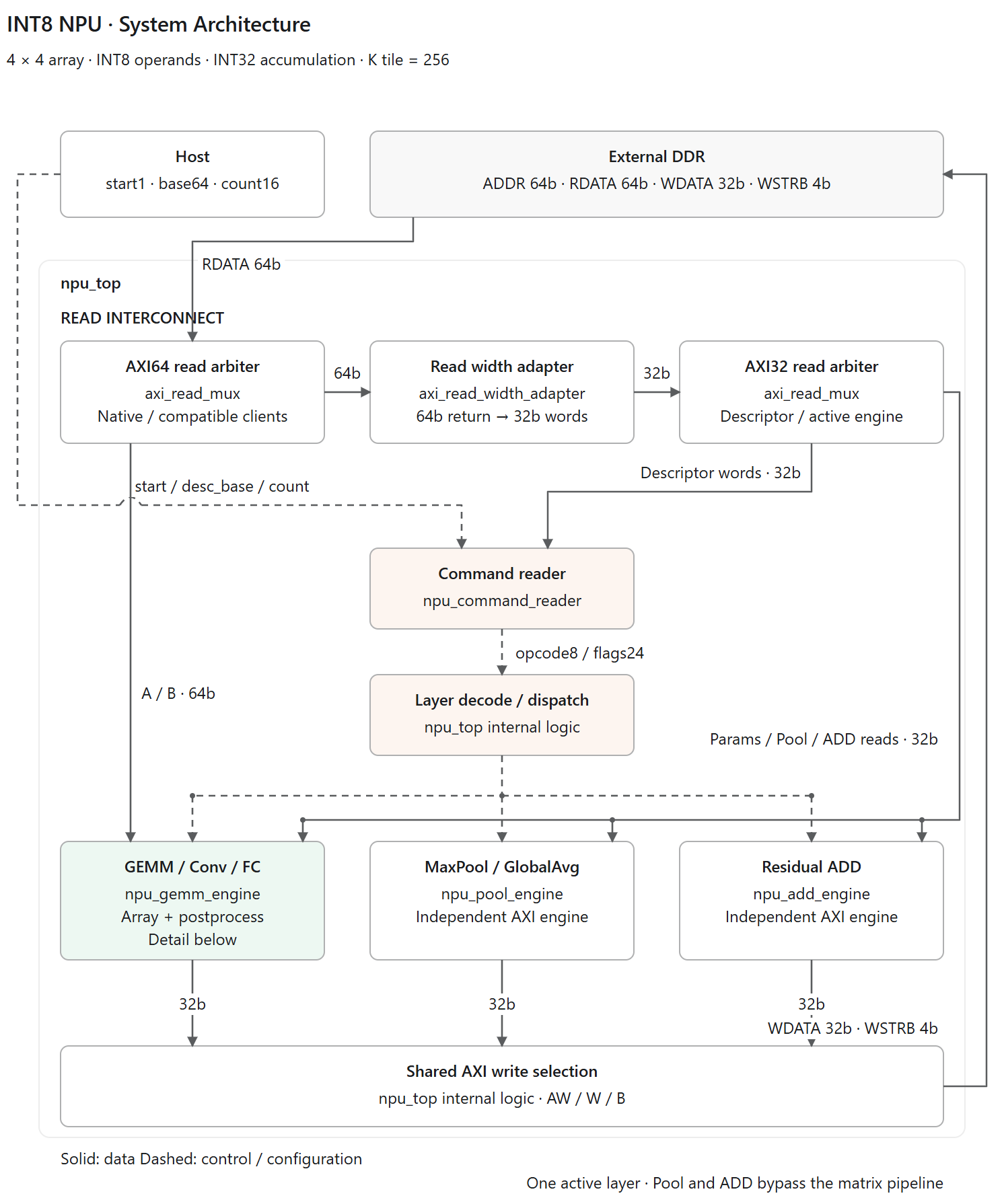
Designed the INT8 MAC array, INT32 accumulation and quantized postprocessing. Tiled scheduling, A/B double buffering and data reuse coordinate transfers, computation and writeback.
Implemented operator mapping, weight layouts, quantization conversion and DDR allocation. ResNet-50 compiles into 72 hardware tasks for autonomous execution by the NPU.
Built an independent integer reference model to check each layer and the complete DDR contents. Matched-condition benchmarks measure the gains from double buffering and subsequent optimizations.
Compared with the serial-loading baseline with Burst enabled, the current design uses 59.65% fewer cycles, equivalent to a 2.48× speedup at equal clock frequency.
The tests use ONNX model weights and synthetic INT8 inputs to check integer results and compare RTL execution cycles under matched conditions.
The current design retains native 64-bit operand reads, A/B double banks, output-stationary accumulation, cross-K input reuse and partial-sum slots. The convolution read cache has been removed. The hardware supports local convolution/pooling fusion; this ResNet-50 workload executes its 72 tasks separately, exchanging data through DDR.
This diagram records the design before cleanup, including the 2 KiB convolution read cache removed from the current implementation. SRAM depths, widths and partial-sum paths are retained here as an earlier architecture record.
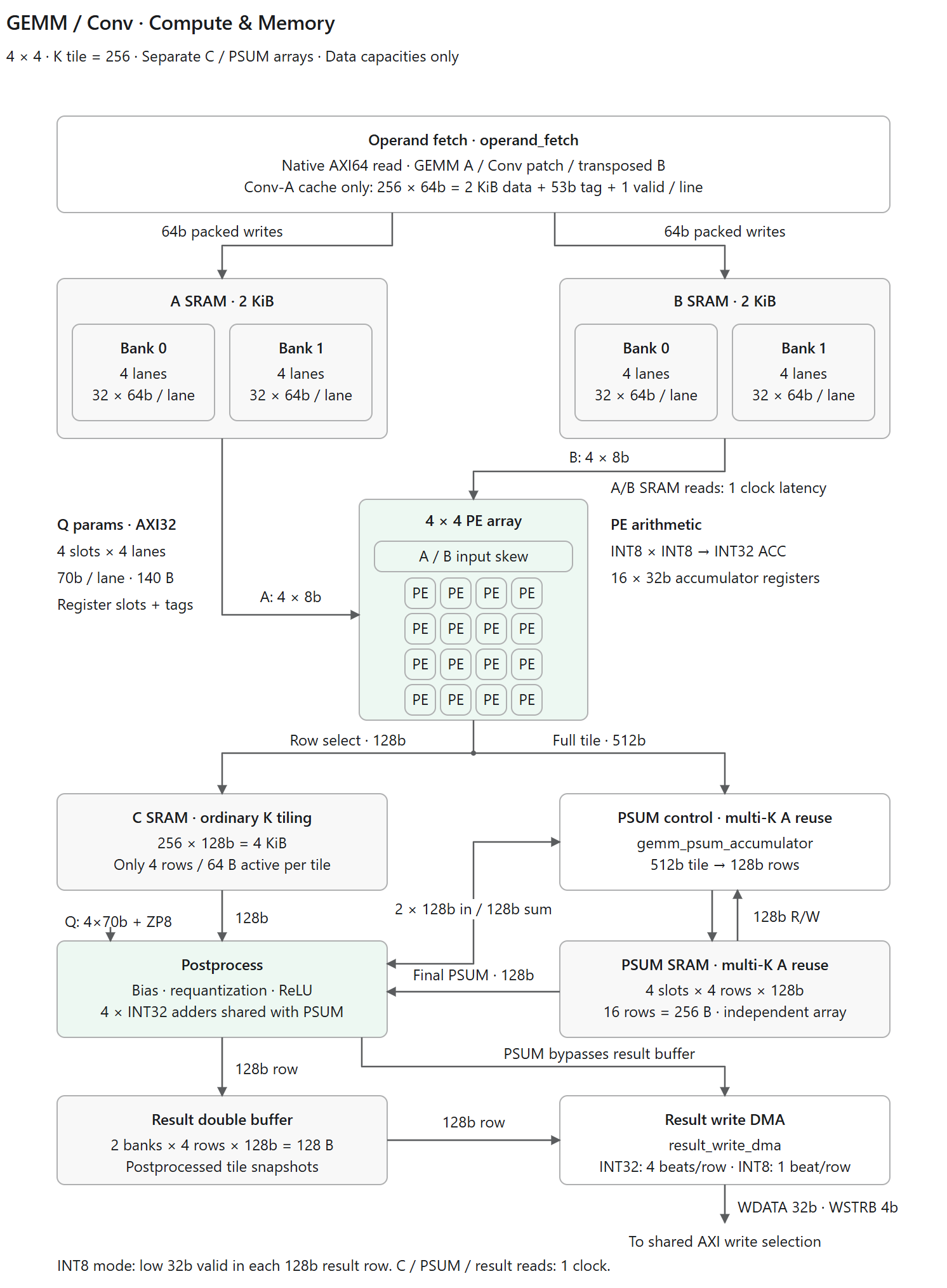
An earlier design reduced cycles from 531,563 to 74,527 (85.98%) through input-tile reuse, AXI Burst and word assembly. All five layer outputs matched the software reference for four test images.
Earlier native 64-bit and convolution-cache optimizations reduced cycles from 1,486,468 to 1,255,817 (15.52%). A separate fixed configuration passed 140 layer checks across ten images.
After input reuse was added, an early DMA completion could leave the fully connected layer waiting for a one-cycle completion pulse it had already missed. Latching completion from the request phase until both inputs were ready resolved the timeout; output checks and full-network regression passed.
Inserted 16 scan chains covering 75,137 flip-flops and ran stuck-at ATPG, achieving 78.58% fault coverage. A separate single-SRAM MBIST experiment passed normal-operation and fault-injection checks.
The run produced 16,502 patterns with 92.19% test coverage. Uncollapsed fault statistics give 50% credit to possibly detected faults: fault coverage uses all 2,747,638 faults, while test coverage excludes 405,530 undetectable faults.
MBIST connects DW_mbist_ctrl and DW_mbist_apg to a 32×64 single-port SRAM. The fault-free memory passes; forcing read-data bit 0 to zero produces a detected fault, with reads and writes to all 32 addresses.